
Moffitt Library’s new ‘(Inter)connected’ exhibit puts student voices and the learning process on display

Originally published on berkeley.edu by Dan Vacarro
Nicole Brown had a big problem to solve.
She was tasked with filling the large empty exhibit space just inside the public entrance of the soon-to-open Carol T. Christ Center for Connected Learning at Moffitt Library. What to do with that exhibit — and what not to do — had her stumped.
As the head of the library and a key leader of the yearslong renovation, Brown returned to the project’s guiding themes: learn, collaborate, make, and reflect. She was sure those four verbs could offer a solution.

During a meeting with one of her colleagues, inspiration struck. And Brown reached for her notebook. In blue ink, she sketched an L-shaped bank of cases. Scrawled words came next, delineating sections built around each theme.
“I had to break free of the paradigm of an exhibit being a thing … that’s complete,” Brown said.
Most exhibits, she explained, arrive finished, remain for a time, and then give way to an entirely different show. Brown envisioned a more organic model: a lasting conceptual framework whose contents could evolve with the students and the building itself.
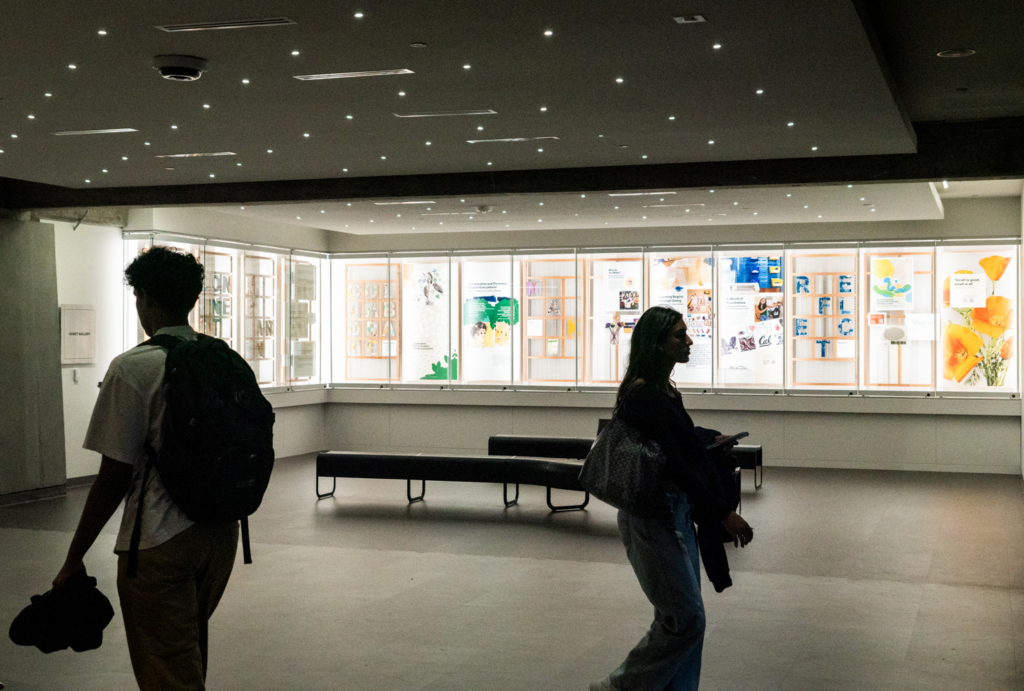
With help from a team of collaborators, her sketch became a mood board, then a set of raw materials, and ultimately (Inter)connected, the eye-catching new exhibit on display now in the Koret Gallery.
The exhibit’s 14 colorful cases highlight students’ questions, conversations, experiments, and reflections — and, of course, the ways those things interconnect. The experience is also something of a guide to the library’s purpose, showing not simply what students produce there, but how the space supports them in their process.
“We get to tell the story of what our building makes possible,” Brown said. “The story of what the library does in relation to learning, collaborating, making, and reflecting is a story we have to tell.”
Where learning begins
Students are the protagonists of that story. Their words and work are woven throughout.
“We wanted to put students’ voices first,” said Jen Brown, Berkeley’s undergraduate learning and research librarian, who worked closely with Nicole Brown to develop the exhibit.
In the Learn section, those voices appear as questions. The cases feature students near the beginning of the research process, still figuring out where their curiosity might take them.

Pulled directly from UC Berkeley Library-led research workshops, the questions range widely. One student is investigating artificial intelligence’s influence on the film industry. Another is exploring how neuroscience and robotics might improve prosthetics.
That unfinished quality is intentional, according to Jen Brown. The curatorial team wanted to create a space that honors the full spectrum of students’ learning process.
“[Students are] so hard on themselves,” she said. “They’re expecting such large, groundbreaking contributions. … Sometimes I’m like, ‘You have a month to write this paper. You’re not expected to have a scientific breakthrough yet.’ … So yeah, we’re just honoring where they start.”
In the Collaborate section, those questions become conversations. One case re-creates an advanced undergraduate research seminar in which students interviewed one another about their research.
“The interview is a great way to share ideas and get feedback,” one student reflected afterward.
Making space for the whole student
Not all learning at the library happens over a book or laptop.
In the Make section, the creative process takes center stage. The cases celebrate what students create in the Maker Studio and the experimentation required to get there.
Sketches for a stamp appear alongside carved blocks and test prints. Crocheted roses share space with artwork and a 3D-printed bridge prototype. Much of this work was created and curated by students in the Undergraduate Library Fellowship program, with guidance from Oliver Murray, the maker education service lead.

Students didn’t just supply the work inside the cases. They helped make the exhibit itself. Ashley Vargas-Mayo ’27, a student employee with the Library’s communications team, joined early brainstorming sessions about how the four themes might take physical form.
Working with lead designer Aisha Hamilton, Vargas-Mayo helped style the large handmade letters used throughout the exhibit, even suggesting cyanotype printing, a technique she had never tried. She gathered flowers, dried and pressed them, and then experimented with exposing them to sunlight on chemically treated pages. Some flowers and leaves produced delicate details. Others, she recalled, became “just a big circle of nothing.”
The waiting was unfamiliar, too. Vargas-Mayo usually works on digital art or with markers and graphite — media that offer more immediate results.
“It really taught me a lot about trial and error,” she said of the two-month project, adding that she never expected that her student job would give her an opportunity to use her creativity on such a large-scale project.
“We hope that, as students enter this new site for study and collaboration, they can take a moment in the gallery to appreciate the curated exhibits from their peers and reflect on the world around them.”
— Jeffrey Farber, Koret Foundation CEO.
The final section of the exhibit, Reflect, slows things down. A tiny handmade artist’s book, Small Is All, sits alongside poppy seeds, a pairing meant to evoke how something small can eventually become something much larger. Nearby are the words of a Berkeley senior who participated in a Library workshop: “Rest is an important element of the intellectual exploration process.”
For Nicole Brown, that message is essential. Learning, collaborating, and making all require time to step away and let ideas settle.
“That section is the most meaningful to me,” she said, and she hopes visitors come away understanding that reflection “is part of the whole package.”
Like the learning it celebrates, (Inter)connected isn’t meant to remain frozen in time.
In Collaborate, a panel names the students and Library workers behind the exhibit’s inaugural iteration, among them Tor Haugan, a Library writer who served as the project’s primary editor. But the panel also contains conspicuous blank spaces — placeholders for collaborators still to come.
That incompleteness is by design. While learn, collaborate, make, and reflect will remain the exhibit’s anchors, the work beneath them will change. The team envisions students helping curate future iterations, adding new voices and work to the cases.
“In five years, I’d like to see more names in that collaboration space,” Jen Brown said. “And that will tell me that we have, you know, we’ve done what we set out to do, which is not just make something for now, but make something that students continue to shape going forward.”
Read more here.


